blues..

blues..
::every cloud has a silver lining:: @ ::天無絕人之路 ~:~ 明天會更好:: @ ::tiān wú jué rén zhīlù ~:~ míngtiān huì gènghǎo:: @ ::天無絕人之路 ~:~ 明天會更好:: @ ::tiān wú jué rén zhīlù ~:~ míngtiān huì gènghǎo:: @ ::every cloud has a silver lining::

Pages

Apr 6, 2015

இ QingMing清明节

Yesterday (05April2015) marked the official day for celebrating QingMing festival, one of the Four Major Traditional Chinese Festivals, observed by the Chinese community of the Daoist/Buddhist faith. Phrases (in Cantonese) like ‘Where and when you gonna ‘haang Qing行清’ ? lit. *'walk Qing' are pretty common these two weeks. What is this Qing all about?

清明节 QingMing Jie lit. translated as ‘clear’ (Qing) & ‘bright’ (Ming) festival or tomb sweeping day which usually falls on 4 - 5 April each year, celebrated either 10 days before or 10 days after the official QingMing day.

This festival originated in the 7th century BC, started by an accidental tragedy set upon by the Duke Wen (pinyin: 晋文公) of Jin himself who was so overwhelmed with grief of his lost friend and subject Jie Zitui (pinyin: 介之推) in a forest fire. The Duke created the Hanshi Festival (pinyin: 寒食节 or Cold Food day) to commemorate the loyalty of his subject Jie Zhitui. Another version of QingMing Festival involved the Tang Emperor, Xuanzong in 732 who was well known for his frugality as not to indulge in extravagant ceremonies in Tomb Sweeping Day or Ancestors Worship Day. Gradually over the years the practice was adopted by the masses throughout different eras and  eventually combination of both traditions, the Hanshi and Tomb Sweeping Day into the QingMing Festival and kept as a one-day festival.


Across the globe, they commemorate their ancestors by sprucing up the graveyard, sweeping the tombs, removing weeds, burning incense and paper money including the high-tech paper stuff like mobile phone, tablet etc. The Chinese society places great emphasis towards filial piety and has high regards of remembering its roots. In Chinese mythology there is this 三魂七魄 *pinyin: sān hún qī pò* ~ three immortal souls and seven mortal forms. Perhaps another great opportunity for a future post on sānhúnqīpò? Setback is, as a Bananaz (who cannot read and write Chinese), the ever loving friendly dumb professor Mr Google is not able to provide a clear translation on the seven mortal forms. It may take awhile to get the right source and translation. Coming back to the three immortal souls ~ when someone dies, the 1st soul goes to meet Yanluowang 閻羅王, the god of death and the ruler of Hell who is also the judge who passes judgment on all the dead, the 2nd soul goes to the the grave and the 3rd soul goes to the ancestral pedestal/tablet (pinyin:神主牌 shénzhǔpái) placed at the ancestor’s hall, house or temple. Most importantly regardless of wherever the soul is, one thing for sure QingMing is able to enhance the togetherness of the entire family members as an outing at the cemetery year after year.

Image courtesy of Sin Chew Daily
Changes happening in China..A new high-tech way of inscribing QR code onto the Tombstone head, a picture paints a thousand words...!!!Anyway in this modern era most memorial parks are pretty well organised and orderly, practically sweeping of tombs are kept to the minimal as they are well maintained.


Online services are available too through internet memorial services for QingMing catering mainly for those who are too busy with work or staying too far away from home. Quite strange to hear people whining about the long traffic jam when going to cemetery for QingMing as it is only once in a year affair but seldom hear complains of traffic jam or long queues at shopping cash counters every week or months. Life is like that?


(Thanks to Twilight Man for all the encouraging words thus sweeping away the dirt & clearing the cloudy weed of returning to blogging after MIA for 8 months. Lucky for Bananaz who somehow survived the gruesome 5 hours left, right and center deep frying by Twilight Man haha.) 

Aug 5, 2014

இ First time flying..

Heard quite a lot of the good, bad & ugly of this popular 'Everyone Can..' airline. Finally Bananaz's very first time on board an 'AAX' flight for a 5 days due diligence trip. The last and my best holiday trip was Egypt, a couple of years ago. So far so good nothing much to complain about this no-frills aircraft. ETD/ETA was on time, no hiccups, a pleasant journey all the way to Pudong, Shanghai. Please do not have high expectation of picturesque views or food as they are not in my area.


Shanghai Pudong International Airport


Great choice of Kempinski Hotel in Suzhou for the Convention.


Yunyansi Pagoda *云岩寺塔* also called Tiger Hill Pagoda by the locals of Jinchang District and ranked #5 of 304 attractions in Suzhou by tripadvisor. Built in the year 959A.D. and was completed in Song Dynasty 961A.D. It is a seven-storey brick building designed in wood structure with a height of 47.7 meters, which is also the earliest octagon-shaped pagoda now known to be extant. It leans towards north east with a lean of 3.59 degrees. In 1961, this landmark in the Suzhou section of the Grand Canal was enlisted as a major cultural heritage protect at the national Level. 


No prize for guessing the name of the trees (know the pixz is too small). Missed out on one pixz of a huge 390 year old gingko biloba tree as Bananaz was too engrossed with the technical details surrounding the tree than the whole tree itself. Try to see if the fruits or leaves below could give you some clues...

...its ginkgo fruits 


Mango posing in front of the Suzhou train station en route to Shanghai. The wordings are made from some nice fine grown grasses, in Mandarin it says 'Suzhou Welcomes You' *Suzhou huān yíng nǐ*.

The famous must eat 'little dragon pao' when in Shanghai. Kinda tough to suck the hot steamy juice using a straw will need lots of special skill. Try sucking a cuppa of hot coffee/tea with a straw to assimilate the burning effect?


This is the driver seat of all taxis in Shanghai which are all fully protected for safety reasons. Impossible to stab or gag the driver from behind.


Cute little 'silent' electric motor bikes.


Very common to see these dragon-turtle in City God Temple of Shanghai. Sorry no idea on the names of the two cute animals on the left and right of the elephants


o.O a huge Chinese abacus hanging on top of the ceiling in 'City God Temple of Shanghai' *上海城隍廟 Cheng Huang Miao*, a good tip from blogger Rurousha to look up for nice stuff above eye level when entering temple. Abacus is closely associated with counting and also a popular feng shui cure for wealth. The abacus has an upper deck with two beads (5 units per bead) on each rod and the lower deck with five beads (1 unit per bead). Based on the placement of the beads it shows the number  9736720123568. Any experts in numerology to decode the numbers? Bananaz googled and discovered the 13 numbers are linked to Daoism and the answer is HERE.


These converted containers are looking good C&G *Cheap & Good* merely from RMB6 per night sleeping on double decker beds.   


The other side of Shanghai


Peddlers in action right at the front of the 'you know what' building along the famous Nanjing East Road. Opening offer price for a pair of clipped-on roller skates with lights at RMB80 but later rolled down to RMB50. When luck was not on her side its a final RMB50 for two pairs. Sure its final?  


If you have not visited The Bund they say you have not been to Shanghai. That's Mango at The Bund, by day & by night. The last trip to Shanghai was in the 90s we sort of  missed out The Bund or most likely Bananaz could suffer from an  early stage of STML *Short Term Memory Lost*.


The changing of lights and words intermittently. A pretty nice place to enjoy the evening and the walk. After Shanghai what's next?

Jul 4, 2014

ക WhyAskWhy¿ (14) An inch of time? 一寸光陰一寸金?

Time and tide waits for no man Bananaz. Gosh time flies. Tempus fugit with just a blink of an eye and half a year has gone by already since his last CNY post. An old Chinese idiom that stresses the value of time by the inch and it goes like this : ~ '一寸光陰一寸金,寸金難買寸光陰' *yī cùn guāng yīn yī cùn jīn, cùn jīn nán mǎi cùn guāng yīn* "An inch of time is worth an inch of gold; yet you can't buy an inch of time with an inch of gold." *Guāng yīn* 光陰 refers to the sun's shadow which is equivalent to time, lit. An interval of time is worth an ounce of gold, money cannot buy you time. Time is precious and must be treasured.


Why*Ask*Why time is being measured by units of length in olden China? The answer lies in the most ancient time-measuring instrument used which consists of two parts, the gnomon-and-ruler *guibiao* 圭表. The gnomon (pronounced 'noh-mon') *biǎo* 表 is the post or stone pillar standing upright on the ground to cast a shadow on the marked tablet called the ruler *guī* 圭. Since time can be measured by the length of the shadow, thus to describe the duration of time with  "inch" simply sounds logical.


image courtesy of hua.umf.maine.edu


"In the nick of time" is an English idiom for 'at the last possible moment' where a nick was a mark on a stick which was used in the past to measure time. Ancient Chinese would use 'in the inch of time' and in school we learned about seconds and hours. In this modern era the younger generation got a cool way of telling time, saying 'see you in a bit'? Any idea what to expect in years to come for the next new generation to tell time?

Jan 19, 2014

இ Horse Up 馬上

Time not only slithers time just flies. The 'Snake' would be hissing goodbye pretty soon to make way for the Horse. Bananaz wanna apologies for MIA over couple of months been busy and hectic with overseas trips. The coming Horse Year will be a very special and unique year. Based on the lunar calendar, the year of Horse will commence on 31 January 2014 and ends on 18 February 2015. So this year we will have 2 occurrence of the first solar term or 立春 *lichun* (beginning of spring) within a year which is on 4 February 2014 and 4 February 2015. This makes the Year of the Horse a 'double spring year' 双春年 *shuāng chūn nián* plus a 閏月*rùn yuè* ie a leap 9th lunar month in this year. The old folks believe this is a good omen especially for wedding ceremony and giving birth. The next double spring year will be in the year of Rooster in 2017.

What's next?

The story above on 'The Clever Old Man' reminds us NOT to mess with old people. The three panicky pretty ladies "horse up" 馬上 *mǎ shàng* jumped out of the pond immediately with lightning speed regardless of wearing nothing.  馬上 *mǎ shàng* lit. ''horse up'' means ~ at once / right away / immediately / (on horseback).

We all know most Chinese words are based on pictograph, see how the word evolved gradually comparing the top pixz with the four legs and tail and a nice mane on the head. However the traditional word for horse '馬' *mǎ* was further simplified to '马' *mǎ*.


Found something quite interesting about the U.S. Postal Service while surfing the internet. USPS (U.S. Postal Service) is honoring the Chinese culture with The "Year of the Horse" stamp, the latest in the postal service's 12-year Lunar New Year stamp series, which runs through 2019. The stamp, which features drums and a small horse in the upper left corner, "signals that fresh beginning" of a new year.


For this Horse Year the most popular idiom which would be overly mentioned is 馬到成功 *mǎ dào chéng gōng* lit. 'horse arrives, succeed' (meaning: to win instant success).  For more idioms to use during this coming CNY can refer to last year's idioms which can still be applicable other than those snakey idioms.

Here's wishing ALL A Happy & Horseperous New Year with 馬上有錢 *mǎ shàng yǒu qián* 'immediately got money' (horse back got money).

Jan 1, 2014

இ Happy 2014


Here's wishing all a very happy new year, a new year a new beginning. Today is the first blank page of a 365 page book. Write a good one. Happy 2014.

Jul 22, 2013

இ Chinese Kinship

Two men struck up a conversation in a pub and one of them kept complaining of family problems with 同父異母 *tóng fù yì mǔ* 'same father but different mothers'. Finally the other man said: "You think you have family problems? Listen to my situation". "A few years ago, I met a young widow with a grown-up daughter, we got married and I got myself a step-daughter. Later, my father married my step-daughter. That made my step-daughter my step-mother and my father became my step-son. Also, my wife became mother-in-law of her father-in-law."

"Much later the daughter of my wife, my step-mother had a son. This boy was my half brother because he was my father's son. But he was also the son of my wife's daughter which made him my wife's grandson. That made me the grandfather of my half brother."

"This was nothing until my wife and I had a son. Now the half sister of my son, my step-mother is also the Grandmother. That makes my father, the brother-in-law of my child, whose step-sister is my father's wife, I am my step-mother's brother-in-law, my wife is her own child's aunt, my son is my father's nephew and I am my OWN GRANDFATHER!"

"And you think you have FAMILY PROBLEMS!?"


It was a pleasant Sunday morning, so nice to 𨅝檯腳 *jaang3 toi4 goek3* 'stretch table leg' 'Cantonese: lit. stretch one's legs over the dining table legs' with Mango enjoying a simple dimsum breakfast. We noticed a family of four sitting across the next table having similarity in their facial features. Out of curiosity we 'played' Sherlock Holmes in guessing their relationship. Bingo! When the kid uttered two words, he solved the mystery for us by just calling out 叔公 *shūgōng* to the guy wearing the checked shirt. On the boy's right is his father and the older man on the far left is his grandfather and the guy at the center with checked shirt whom the kid called out as 叔公 *shūgōng* is his grandfather's younger brother aka Great Uncle.

sisters, brother, 舅 *jiù* 'uncle', 姨 *yí* 'aunt', 表 *biǎo* 'cousins'

Excerpt from Wikipedia: The Chinese kinship system (traditional Chinese: 親屬系統; pinyin: qīn shǔ xì tǒng) is classified as a Sudanese kinship system (also referred to as the "Descriptive system") used to define family. Identified by Lewis Henry Morgan in his 1871 work Systems of Consanguinity and Affinity of the Human Family, the Sudanese system is one of the six major kinship systems together with Eskimo, Hawaiian, Iroquois, Crow, and Omaha. The Sudanese kinship system (and hence the Chinese kinship system), is the most complicated of all kinship systems. It maintains a separate designation for almost every one of ego's kin based on their generation, their lineage, their relative age, and their gender.


In the Chinese kinship system: Maternal and paternal lineages are distinguished. For example, a mother's brother and a father's brother have different terms. The relative age of a sibling relation is considered. For example, a father's younger brother has a different terminology than his older brother.

Bananaz Paternal lineages:
伯 *bó* dad's elder brother [paternal elder uncle]
叔 *shū* dad's younger brother [paternal younger uncle]
姑 *gū* dad's elder or younger sister [paternal aunt]
堂 *táng* dad's brothers' children (sons & daughters) [paternal cousins]

Bananaz Maternal lineages:
舅 *jiù* mom's elder or younger brother [maternal uncle]
姨 *yí* mom's elder or younger sister [maternal aunt]
表 *biǎo* mom's brother or sister's children (no seniority) [maternal cousins]

The above may be very confusing and would better stop here for the time being if not it could be stretched to a mile long and that would be even more complicated. For easier understanding the surname of each individual and age factor in terms of seniority from the paternal lineage would determine a different terminology where else for the maternal lineage surname, age and seniority does not apply.

Jul 5, 2013

இ 未见过大蛇屙屎..Big Snake Defecate

Bananaz wanted to have a comprehensive insurance so asked for offers hoping to get C&G *cheap&good* protection. The first company offered: "From cradle to grave" but the second was better: "From womb to tomb." Bananaz was just about to take this when a third company came up with the ultimate offer: "From erection to resurrection!" Here goes the three presentations:

The first presenter 'From cradle to grave' said, "When one of our insured died suddenly on Monday, we got the news that evening and were able to process the claim for the wife and had mailed a cheque on Wednesday evening".

The second presenter 'From womb to tomb' said, "We are better, when one of our insured died without warning on Monday, we learned of it in 2 hours and were able to hand-deliver a cheque the very same evening itself".

The last presenter 'From erection to resurrection' said, "That's nothing! You guys are missing the big picture and most certainly 未见过大蛇屙屎 *pinyin* "wèi jiàn guò dà shé ēshǐ"; Cantonese:"mei6 cang4 gin3 gwo1 daai6 se4 o1 si2" [lit. never seen a big snake defecate before] Our office is on the 20th floor of the Twins Tower. One of our insured who was cleaning a window on the 85th floor, slipped and fell. We handed him his cheque as he passed our floor".

Of course the above presentation or rather a joke may be exaggerated but hopefully may bring home a point to explain this Chinese idiom 未见过大蛇屙屎 *pinyin* "wèi jiàn guò dà shé ēshǐ" [never seen a big snake defecate before].  WhyAskWhy Bananaz does not have the foggiest (not blaming the recent haze) idea how on earth this Chinese idiom of snake poop came into being. Guess the answer is already there we merely have to read between the lines (anyone can please assist). Honestly who have actually seen a live big snake defecate before? None? Simply put, it means that if we have not seen or know about it, does not mean that it does not exists. One must look at life in a wider perspective and not a knowledge barrier over a myopic view. More than often people would use this idiom when ever someone has a lack of knowledge of not knowing the bigger picture or current situation. When do we invite the 'snakey shit' to slam at our face? When someone is trying to be smart alec for example not aware that it's possible to run a mile in less than 4 minutes or building a 30 story hotel in 360 hours, who then uttered 'its impossible'. Then better watch out for this snakey shit idiom 未见过大蛇屙屎 *pinyin* "wèi jiàn guò dà shé ēshǐ" [never seen a big snake defecate before] to roll over the face.

Seeing is believing in just 15 days..


 This idiom 未见过大蛇屙屎 *pinyin* "wèi jiàn guò dà shé ēshǐ" [never seen a big snake defecate before] also serves as a reminder to be humble at all times as life is always in a flux and a never ending learning process with no proven record of anyone known as Ms/Mr. KnowAll.

Jun 27, 2013

இ 天下第一 No.1

Human(e) Race.. [A few years ago at the Seattle Special Olympics, nice contestants all physically or mentally disabled, assembled at the starting line for the 100-yard dash. At the gun, they all started out, not exactly in a dash, but with relish to run the race to finish and win. All that is except one little boy who stumbled on the asphalt, tumbled over a couple of times, and began to cry. The other eight heard the boy cry. They slowed down and looked back. Then they all turned around and went back..every one of them. One girl with Down's Syndrome bent down and kissed him and said, "This will make it better." Then all nine linked arms and walked together to finish line. Everyone in the stadium stood, and the cheering went on for several minutes. People who were there are still telling the story.]

According to snopes.com this story is partly true. This incident happened in a 1976 track and field event held in Spokane, Washington where one contestant did take a tumble and one or two of the other athletes turned back to help the fallen one not everyone in the event. It would be most ideal to be overwhelmed with compassion to turn back without thinking of going for gold in favour of helping a fallen competitor.  Obviously in this real world, life is never kind and not so rosy because majority would be doing their damnedest to aim for Number One be it sports, finances, games etc.

劍~Jiàn (Sword)

Even way back in ancient China where the Swordsman would fight their very best to take on any challenges no matter what it takes, by hook or by crook to be 天下第一劍 [pinyin]:tiān xià dì yī jiàn. 'sky below number one sword' lit. *sky* represents the sky above and *below* for earth, the Chinese way of describing 'World' connecting 'sky+below'. We can only internalise and relate the sword wielding movies of the olden days with a pinch of salt on how genuine it was to go back in time with those men slinging their swords over their shoulders roaming the streets in search of fame and power. With the sophisticated computer graphics software, its unbelievable to see the sword penetrating through the body which looked so real. Unlike those black & white movies shown in the yesteryears of 60's the puzzled and confused Bananaz will often shoot difficult questions to his poor helpless mama. Eg ~ "How come the sword goes under that bad guy's arm pit who shouted loud then can die one?"& "Why after slashing the men, the sword got no blood on it one?"


WhyAskWhy over the years the curious Bananaz, a die-hard fan of swordsman/martial arts movies often baffles over the plot where most filmmakers have something in common. Its just a trivial observation, hopefully the nosey Bananaz is able to stay out of trouble as curiosity killed the cat.

Each time the hero swordsman goes to any restaurant or check-in to Inn how come he has all the money to pay for food, wine and lodging? The wandering swordsman travels without any wrapped around cloth baggage but gets to wear a new set of clothing.

Pants are without pockets and money is in the form of silver nuggets which are tied around the waistband. After all the triple somersaulting, crouching and flying stunts, the silver nuggets are still intact without dropping a single piece. Some movies have improvised slightly with a pouch to contain the silver nuggets secured at the waist band.

Wonder what kind of speed and accuracy for the hero to use his sword to deflect all 20-30 arrows shot at him without being hit by a single arrow? Mama used to say "son Hero must not die one".
The REVENGE factor of 'an eye for an eye, a tooth for a tooth' inspires the script writers. More than often its the fighting and killing one another to get hold of the martial arts manual to achieve invincible power or fighting over a reputable heavenly sword or dragon sabre to be crowned the indisputable 天下第一劍 [pinyin]: tiān xià dì yī jiàn 'World Number One Sword'.

Jun 11, 2013

இ Get Down?

Get Down or Get Out?

In the above Humorous Speech Contest, Marianna Pascal, a renowned writer and trainer on communication skills, presented her speech with great enthusiaism and clarity regarding our local varieties of English or rather Chinglish aka Manglish. To the language experts they may have thorns pricking their ear drums when words like 'what lah you' or 'where got' wriggles through their ears. Some how for those seasoned speakers/listeners of Chinglish/Manglish it would be the least disturbing. Just to touch on one point from the video where most Chinese would agree our mom & dad said this umpteenth times since the day we were born ~ 下車 xià chē *pinyin* lit. 'down car' a direct translation for 'get out of the car'. The obvious opposite is上車 shàng chē *pinyin* lit. 'up car' but its very rare to hear 'get up the car' in Chinglish. 上 shàng *up*/下xià *down* were embedded in our thick skull and over the years saying 'get down the car' in English is second nature.

What crosses your mind when you pick up your Shanghai friend/business associate at the airport who has limited vocabulary of English gets into your car, fastened the safety belt and ready to go and then uttered 'open car' and later on the highway raises his voice with 'kill car'?

 開車 kāi chē 'open car' lit. is operate/drive/start a vehicle and not as what you imagine  spanners dismantling the car.  There is no connection to an act of murder with 殺車 sounds like 剎車 *tQ to Kian Fai Koh & SK*  shā chē *pinyin* 'kill car' but to step on the brakes during any emergency. Of course we cannot simply apply a direct translation word for word or homophones but merely used them jokingly like that also can lah.


Interestingly some Chinese words such as 'Kiasu' and 'Kowtow' are borrowed words and accepted in most English Dictionaries .

Kiasu: is a Hokkien word literally means 'fear of losing' and in pinyin 怕输 *pà shū* where 怕pà  means fear/afraid and 输shū means lose.

Definition of kiasu

noun

  • a grasping, selfish attitude:I should have gone two hours earlier: the kiasu in me is growing

adjective

  • (of a person) very anxious not to miss an opportunity; grasping.

Origin:

from Chinese, 'scared to lose'

source: Oxford Dictionaries


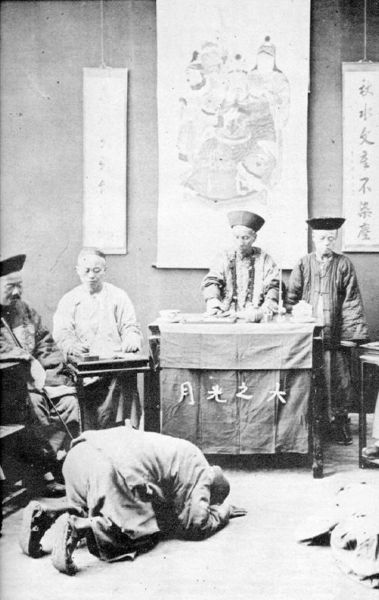
Kowtow: 叩頭 *pinyin* kòutóu where 叩kòu *knock/bow* + 頭tóu *head* which is a traditional greeting especially to a superior involving kneeling and pressing one's forehead to the ground.

Image courtesy of wikipedia
Definition of kowtow

verb

  • 1act in an excessively subservient manner: she didn’t have to kowtow to a boss
  • 2 historical kneel and touch the ground with the forehead in worship or submission as part of Chinese custom.

noun

historical

Jun 3, 2013

இ Cobwebs

It was a great pleasure & pressure at the recent Bloggers Gathering for the very first time with Isaac, Simple Person , SK, Small Kucing, Twilight Man & Suituapui (couple of times already) as most of them were 'complaining' about seeing cobwebs in Bananaz's blog. So sorry folks Bananaz been MIA for quite some time since CNY. Bananaz's blog may be cobwebbed but definitely not abandoned. Surely and slowly will be back pretty soon to beat Twilight Man (TM) before he makes his drastic move. Here is what TM commented ~ "Oh dear, this blog has full of cobwebs in 4 corners! Spiderman wasn't here, was he??Gosh! OMG!!! What is this sticky green slime on the floor in this blog!! Oh no, it is green moss on the floor with lots of fungus and maggots. Help!!!I will be back tomorrow with some detergent and insecticide sprays too."


 BTW Bananaz googled and discovered some spinning information about spider web vz cobweb. The meanings are identical with little or no difference between them as both Spider web and Cobweb refer to the silken threads spun by a spider. The main difference is that, spiders do not live in cobwebs which are no longer in use by the spider that made it. This gives them their thick, gray appearance, dusty and unorganized strands such as those seen in haunted houses. It is believed that the word "cobweb" originates from the Middle English word "coppe" meaning spider, and over the years the word was slurred to become cobweb. In contrast, when you see beautifully designed webs in trees and gardens, this is a spider web which is still in use i.e. clean.

Cobwebbed or Spiderwebbed or Whatever webbed by hook or by crook Bananaz will be right back..;),


  EM Hallowen 98

Feb 7, 2013

இ Year of 蛇 Snake 2013

The Water Snake slithers in un-officially after midnight on 04Feb2013 according to the solar calendar referred to as Lìchūn立春 *pinyin*.  Traditionally Lìchūn or Laap Chun in Cantonese signifies the beginning of spring in East Asian cultures with special village events, worship and offerings to the gods and ceremonies for a blissful and prosperous new year.  It marks the beginning of another cycle for being the very first day of spring when the sun is exactly at the celestial longitude of 315 ° which is divided into 24 solar terms in a year. However the Chinese New Year which is based on a  lunisolar calendar often referred to as the "Lunar New Year"  calendar incorporates both sun and moon (yin and yang combined ) cycle elements  falls on 10Feb2013 in the Year of the 蛇 Snake.
We will be ushering in the Chinese New Year pretty soon and here is a special mention to Autumn Belle who sparked this entry with her comment in Dec2012 and it goes like this [P/S: hope you'll do a post about auspicious words to say for CNY for us bananas to learn and show off during the CNY season]. For fellow bananaz like me hope this few idioms can assist you to over come some of the challenges in wishing friends and relatives with nice four little words or so called favourable Chinese idioms. Hope the translation is in order and would appreciate the help from those Chinese educated readers to point out any mistakes or adding in more idioms, your feedbacks are most welcome. Bananaz was so embarrassed when a lady with a videocam zoomed right at my face requesting for a nice four little words in Chinese during a CNY dinner gathering as nothing could leave the lips as Bananaz was dumbfounded.


 蛇年大吉
pinyin: shé nián dà jí
cantonese: se4 nin4 daai6 gat1
english : lit. snake year big luck
[very auspicious / extremely lucky in the Year of the Snake]


龍馬精神
pinyin: lóng mǎ jīng shén
cantonese: lung4 maa5 zing1 san4
english : dragon horse full vitality
[with full vitality and spirit of a dragon & horse]


萬事如意
pinyin : wàn shì rú yì
cantonese : maan6 si6 jyu4 yi
english: lit. 10,000 things according to your wishes
[may your 10,000 wishes come true]


大吉大利
pinyin : dà jí dà lì
cantonese : daai6 gat1 daai6 lei
english : lit. big luck/propitious big gains/profit
[great luck great profit]


五福臨門
pinyin : wǔ fú lín mén
cantonese : ng5 fuk1 lam4 mun4
english : lit. 5 fortunes approach door
[5 blessings bestowed upon your household (ie longevity, wealth, health, virtue & a natural/peaceful death)]


招財進寶
pinyin : zhāo cái jìn bǎo
cantonese : ziu1 coi4 zeon3 bou2
english : lit. ushering prosperity enter treasure
[ushering in wealth and prosperity]


生意興隆
pinyin : shēng yì xīng lóng
cantonese : sang1 ji3 hing3 lung4
english : business prosperous
[may you have a prosperous/flourishing business]


金玉滿堂
pinyin : jīn yù mǎn táng
cantonese : gam1 juk6 mun5 tong5
english : gold jade fill hall
[may you have abundance of wealth]


迎春接福
pinyin : yíng chún jiē fú
 cantonese : jing6 ceon1 zip3 fuk1
english: lit. welcome spring receive fortune
[to welcome spring/joy to receive fortune]


Gong Xi Fa Cai & Happy Holidays and May All Your Wishes Come True 心想事成 *pinyin*xīn xiǎng shì chéng; *cantonese*sam1 soeng2 si6 seng4.

 
Design by Free WordPress Themes | Bloggerized by Lasantha - Premium Blogger Themes | Blogger Templates